🎬 Get It in Writing: What the Obsession Lawsuit Can Teach Independent Filmmakers
Sep 09, 2026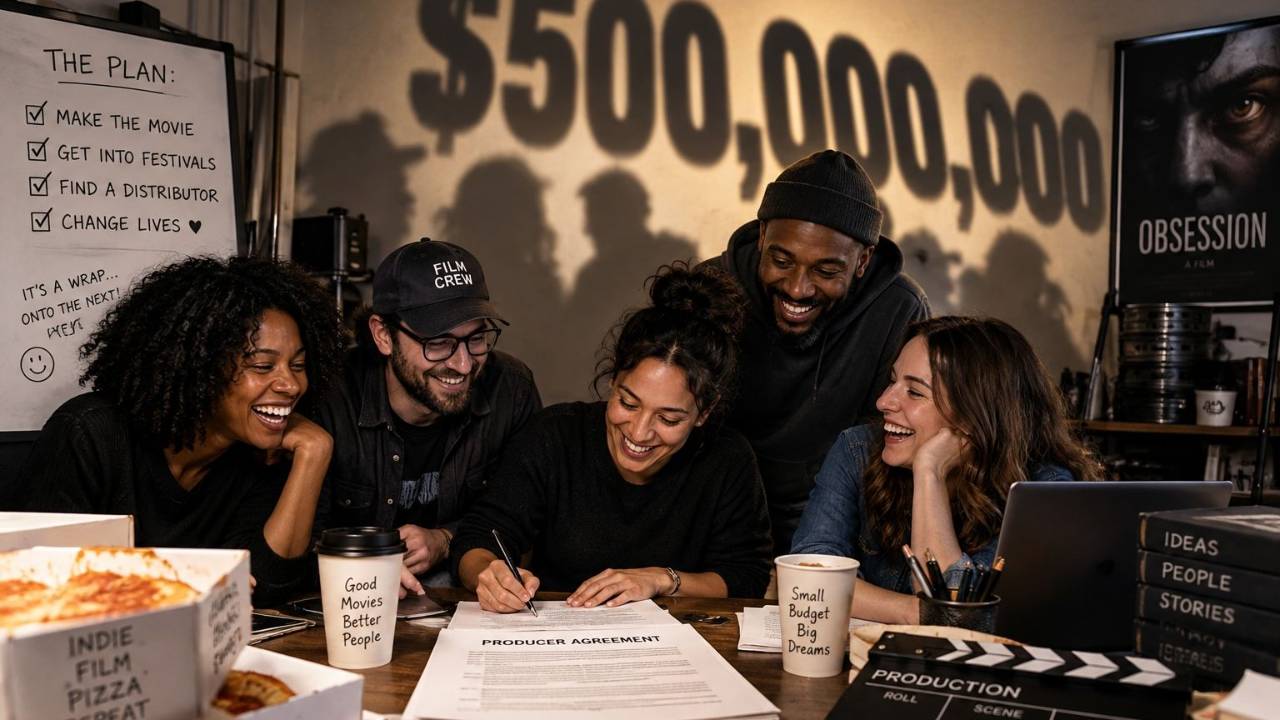
Here's one of those blogs where I have to start by saying:
I am not a lawyer. Nor do I play one on TV.
Nothing in this blog constitutes legal advice. It's based on my experience and knowledge from working in the entertainment industry for many years. Learn from it, but by all means, do your own due diligence—and when the time comes to put your John Hancock to paper, hire an attorney when you need one.
Okay, now that we've gotten that out of the way...
One of my favorite sayings is:
Get it in writing.
I don't care what it is. Document it.
Going into business with your spouse, mother or best friend?
Get it in writing.
Someone asks you to make Thanksgiving dinner?
Text them to confirm the menu.
You and your best bud are planning a trip together?
Put the plan in an email so everybody is on the same page.
At the very least, you'll have something to point to later and say:
See. This is what you said.
Which brings me to Obsession.
Now, I don't know if you've heard of the movie Obsession...
I jest.
You're a filmmaker who's up on your stuff. Of course you've heard about arguably one of the biggest independent film success stories in recent memory.
Made for a reported budget of roughly $750,000, Curry Barker's horror film has grossed more than $500 million, let me say that again, $500 Million worldwide after being acquired and released by Focus Features.
But have you heard about the subsequent lawsuit filed by one of the film's producers, Leonora Ann Darby, against Tea Shop Productions and its co-founders James Harris and Mark Lane?
Chile...Grab a mug. I've got some tea to share.
The Obsession Behind-the-Scenes Drama
Darby, who is credited as an executive producer on the film, has filed a 135-page complaint alleging, among other things, breach of contract, retaliation and unfair competition. She claims there was a seven-year pattern of unequal treatment and broken compensation promises.
Important words here:
She claims.
This is a lawsuit, not a verdict. Tea Shop disputes her allegations and maintains that she received what she was owed.
But you already know the first thing that crossed my mind when I heard about the lawsuit:
I hope she got it in writing.
Now technically a verbal agreement is still binding, the trick is proving what was said. According to Darby's complaint, she had an agreement that entitled her to one-third of Tea Shop's net profits on projects where she served as lead producer. She alleges that she played a significant role in getting Obsession back on track—including pushing to return Curry Barker to the editing room and advocating for reshoots and story changes.
She also alleges that once the film became a hit, she was excluded from the press tour and Los Angeles premiere and ultimately credited as an executive producer rather than a producer. And when she brought it to their attention they offered her $300,000 with, according to her, continued backend participation.
And that's where this gets especially interesting to me as a producer.
A Producer Credit Doesn’t Necessarily Tell You the Deal
If you don't know, an executive producer credit on a feature film can mean many different things.
Someone may have helped secure financing.
They may have introduced key people.
They may have provided resources.
Or they may have been deeply involved in producing the movie.
The title alone doesn't necessarily tell you what that person's financial participation is. You know what does?
The contract does.
And that's the point. I can’t stress this enough. GET EVERYTHING IN WRITING BEFORE YOU START THE WORK.
Just because you made a major contribution to a movie doesn't automatically mean you own part of that movie or even that you will get compensation for what you’ve done.
Just because everyone calls you "producer" during production doesn't necessarily mean you're entitled to backend.
And just because somebody promised you something over dinner doesn't mean you're going to have an easy time proving it three years later when the movie makes $500 million. Mind you, if the film had not been successful we probably wouldn’t be here.
There are such arrangements as work-for-hire. I have worked as a producer-for-hire many times. Pay me an agreed upon rate and when my work is done it’s done. You don’t owe me anything on the back end, I’ve been fully compensated for my contribution, and you retain full ownership. These days I always get a little something on the backend.
That's why you need to spell everything out in writing:
What is my title?
What are my responsibilities?
How am I being compensated?
When am I being paid?
Do I have backend participation?
What exactly is that participation based on?
How is "net profit" defined?
Do I have audit or accounting rights?
What happens if my credit changes?
What happens if the film is sold?
Before you do the work.
Not after the movie becomes a mega hit. In the immortal words of The Notorious B.I.G., “It’s like the more money we come across, the more problems we see”. Get it in writing.
On another note, Darby alleges there was a seven-year pattern of unequal treatment and broken compensation promises toward her by Tea Shop Productions’ two producers. I would implore you: do not stay in a situation where you are being mistreated for years. If, indeed, her contributions are what helped the film become this successful, and the company had been mistreating her, then they didn’t deserve this success off of her work. But more importantly, the film wouldn’t have been this successful—if we assume all she claims is correct.
Now, in my best Kendrick Lamar voice...
Bear with me for a second, let me put y'all on game.
Because this lawsuit also gives us an opportunity to talk about something independent filmmakers need to understand how movie money works.
A $500 million box office gross does not mean the filmmakers have $500 million sitting in a bank account waiting to divide it up.
This is where the waterfall comes in. A waterfall is simply the order in which money generated by a film gets distributed. Think about an actual waterfall. Money comes in at the top and starts trickling down. Different parties get paid at different points.
For example, the theater keeps a portion of the ticket revenue. The distributor may then deduct contractual fees and recoup certain expenses. Depending on the deal, investors, producers and talent may receive money at various points in the waterfall.
Only after all of that do you arrive at whatever the contract defines as the remaining profit pool.
And that definition matters enormously.
Let's Do Some Hypothetical Math
Obsession has grossed more than $500 million worldwide.
But let's be very clear:
The following is NOT the actual accounting for Obsession. I have not seen the distribution, acquisition, talent or producer agreements. I am making guesses on everything except the box office and what Darby herself reported, this is for illustration purposes only based on standard industry accounting.
If the movie grossed roughly $500 million worldwide, the theaters retain a substantial portion of that money, in most cases a 50/50 split. There is a sliding scale split where the percentage of ticket sales the studio takes decreases every week the movie stays in the theaters. But let’s stick with the 50/50 split.
- Total Global Box Office: $505,700,000.
- Distributor receives: $252,850,000.
From the distributor's share would come things like:
- distribution fees (estimate 25% could be as high as 35%)
- acquisition costs: Producers received $16,200,000 upfront
- marketing and distribution expenses: $35,000,000 (estimated based on other releases)
- contractual talent participation: Director, actor, studio level bonuses, Jason Blum reportedly made $17,000,000.
- Overhead and other recoupable expenses
Only after the contractual waterfall has been applied would the production company's share be determined. Let’s estimate all that at: $142M. That leaves $110,850,000 remaining profit pool to be split between the distribution company and the production company.
So, again only an estimate, the production company would receive an additional $55,250,000 this is on top of what they received as their minimum guarantee upfront of $16,200,000.
But wait, then there may be another waterfall inside the production company.
Where they have bonuses promised to crew, investors or overhead. But let’s say they get to keep this hypothetical $55,250,000. Darby would be entitled to one-third of that. That's where someone's definition of "one-third of net profits" becomes very important.
One-third of what?
That's the question.
One-third of $500 million?
Absolutely not.
One-third of the distributor's receipts?
Probably not.
One-third of Tea Shop's defined net profits after all applicable deductions? Still a ton of money and a far cry from $300,000.
And suddenly you understand why a few words in a contract can potentially be worth millions of dollars.
Get. It. In. Writing.
Without knowing all the details of this case, I'm not going to tell you who's right.
That's for the lawyers and potentially a jury to figure out.
But I don't need a verdict to know what independent filmmakers should take away from it.
Get it in writing. And don't just get something in writing. Get the right things in writing.
Your credit. Your compensation. Your responsibilities. Your ownership. Your backend.
How that backend is calculated. What expenses can be deducted before you participate.
When accounting statements are provided. What happens if the project gets sold.
No amount of detail is too much, even on a low-budget, probably-go-no-further-than-a-streamer movie—you never know. That little $750,000 indie might suddenly make $500 million, and now you’re regretting the deal you made, but it’s too late. The filmmakers are not obligated to go back and compensate you based on the film’s outcome—but, but, but—unless you had that in writing.
And if someone gives you grief about putting it in writing—run the other way.
Making the movie is only part of the job. Understanding contracts, credits, distribution, backend participation, and where the money actually goes matters too. I cover the business side of independent filmmaking—and the things filmmakers often don't think about until it's too late—in the Movie Making Masterclass.
🎬 The Microdrama Playbook
Microdramas are exploding and changing the entertainment industry. Learn how to create binge-worthy Vertical Series without sacrificing great storytelling.
When you sign up for a resource, I'll also send you email updates on my latest blog posts, VIP content and the occasional product recommendation. Of course, I will always respect your privacy and data.
Author